Objectives
To bring the research in astrophysics and space sciences to towns and cities far away from the main urban areas and that have less access to science communication activities.
Reach
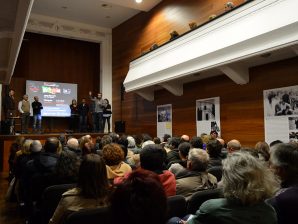
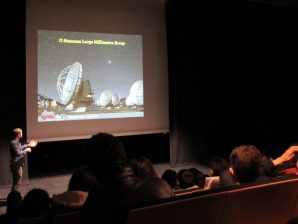
Throughout 2016, this project reached about 2500 people in locations all across the country, mainly inland. It involved 52 researchers in 19 events held in 17 districts and in the Autonomous Region of the Azores.
The events were publicised in some national media outlets and many regional newspapers, websites and radio stations.
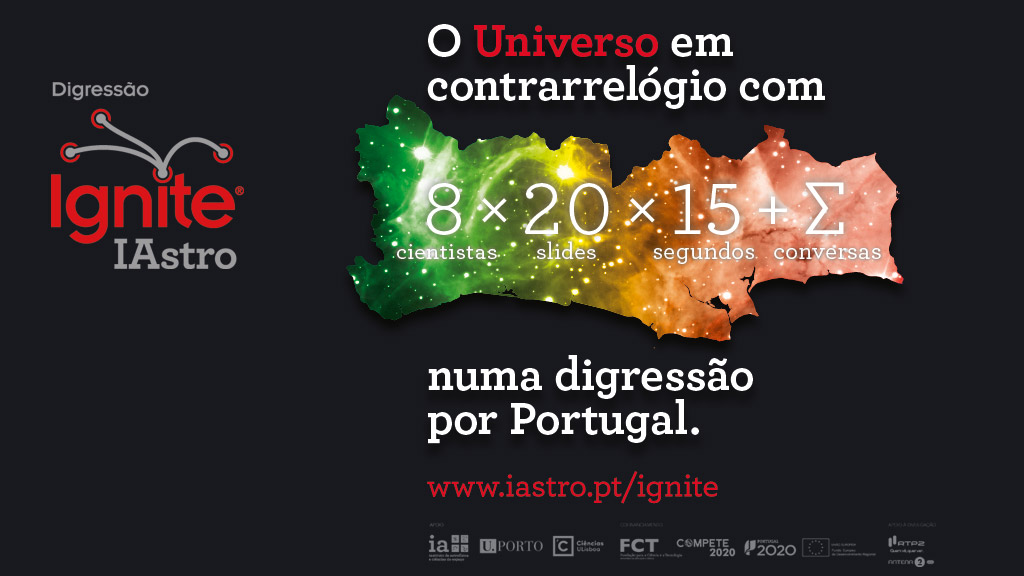
The Universe against the clock on a tour of Portugal
Science doesn’t reach every place with equal ease. The Ignite IAstro Tour wants to bring the national research in Astrophysics and Space Sciences to towns and cities that are farther away from the main urban areas and that have less access to science communication activities.
The compact format of the Ignite IAstro events enables the presentation, in less than one hour, of the diversity of topics researched at the Instituto de Astrofísica e Ciências do Espaço (IA).
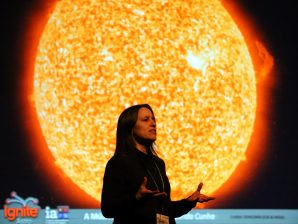
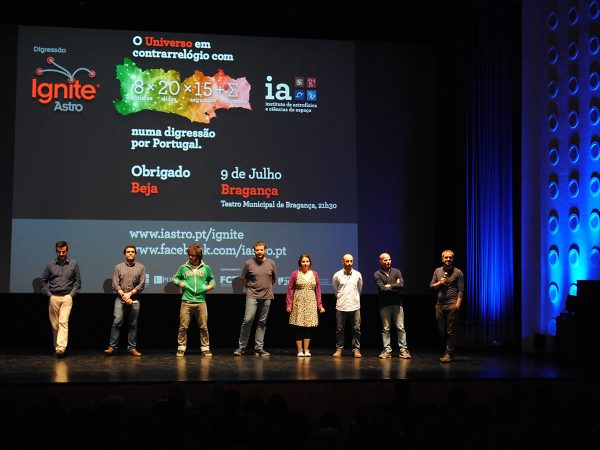
At each Ignite IAstro event, eight to ten IA researchers present their research in only five minutes each. Following the format of the Ignite events, each researcher will have to speak at the pace of a sequence of 20 slides that advances automatically every 15 seconds.
Please visit the Portuguese version of this page for the updated calendar of Ignite IAstro events and the radio interviews.
A race through the Universe against the clock
The teaser video promoting the Ignite IAstro Tour.
Credits: Music: Cinematic Kit 2 by Stefan Kartenberg, available at http://ccmixter.org/files/JeffSpeed68/51517 (Licence Creative Commons Attribution Noncommercial (3.0) http://creativecommons.org/licenses/by-nc/3.0/)
Images: ESO (eso.org) and M.McCaughrean & M.Andersen (AIP); L. Calçada; ESA, G. Miley and R. Overzier (Leiden Observatory) and Davide De Martin (ESA/Hubble); M. Kornmesser; G. HÃŒdepohl
Share
Scope:
National
Coordination:
Instituto de Astrofísica e Ciências do Espaço
Funding:
Instituto de Astrofísica e Ciências do Espaço